
Criminal Cases in DeKalb County Courts
DeKalb County criminal cases are split by court level. DeKalb Circuit Court, part of Alabama's Ninth Judicial Circuit, hears felonies, felony-linked or lesser-included misdemeanors, and criminal or municipal appeals tried again from the start. DeKalb District Court handles most state-law misdemeanors and the first hearing in many felony matters. It may accept a non-capital felony guilty plea when law permits. A felony preliminary hearing in District Court does not turn that court into the court of final felony trial.
The DeKalb County Circuit Clerk keeps both Circuit and District case files at 300 Grand Avenue South in Fort Payne. DeKalb County Circuit Criminal clerk Kim Hamlin and District Criminal clerk LaKayla Ramza use the main clerk number, 256-845-8525, option 2. Municipal prosecutions remain with the city court unless appealed to DeKalb County Circuit Court. That boundary matters: the DeKalb County clerk's request form cannot supply municipal, federal, out-of-county, or out-of-state files.
DeKalb County Court Levels Compared
A court name shows the stage and scope of a DeKalb County criminal case. DeKalb County Circuit Court is the main felony trial court. DeKalb County District Court handles misdemeanor cases and can conduct the first judicial step in a felony case. City ordinance and qualifying city misdemeanor files stay at the municipal clerk. This is why a name may appear in one DeKalb County office and not another.
| Court | Main criminal work | Record route |
|---|---|---|
| DeKalb Circuit Court | Felonies, linked misdemeanors, and appeals tried de novo | Circuit Criminal clerk or Just One Look |
| DeKalb District Court | Most state misdemeanors and felony preliminary hearings | District Criminal clerk or Just One Look |
| Municipal court | City ordinance, traffic, and qualifying city misdemeanor matters | The city court that opened the case |
A municipal charge may reach DeKalb County Circuit Court on appeal. Until then, requesting it from the DeKalb County clerk can yield no record even though a valid city case exists.
How to Search Case Records
Just One Look, also called AlacourtACCESS, is the remote search for Alabama state trial court records. It covers criminal, civil, small-claims, state-traffic, domestic-relations, and child-support cases. A name or case-number search costs $9.99 and includes one Case Detail. A no-match result still counts as a paid search. Exact post-login filters were not public during research, so no birth-date, date-range, export, or wildcard controls should be assumed.
The official Just One Look screen shows the public route into Alabama trial-court search for a DeKalb County case.
See the Just One Look source used for this DeKalb County court image.
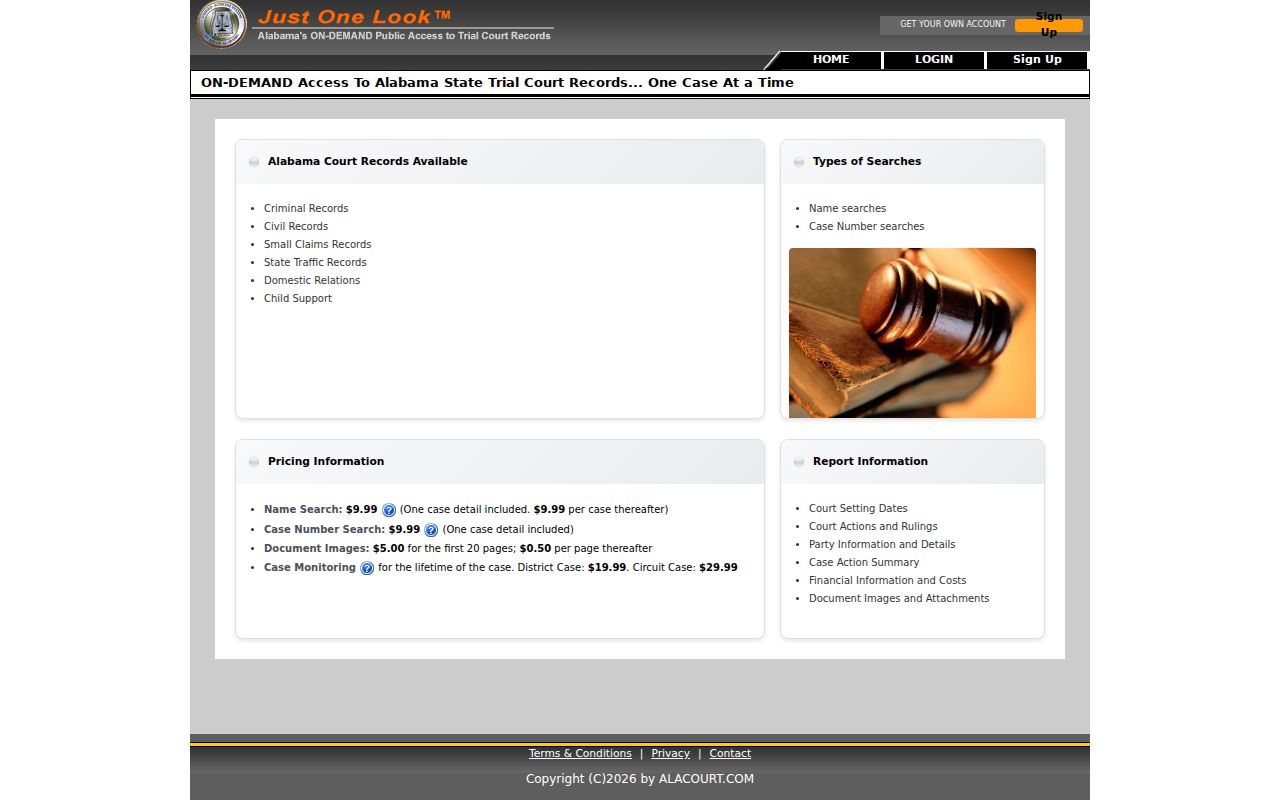
The screen leads to account-based paid access, while the DeKalb County clerk remains the source for certified or portal-missed court records.
- Choose a name search or a known case-number search in Just One Look.
- Check spelling and court level before paying because even no-match results are billable.
- Open the included Case Detail and identify the court, case number, status, and party.
- Read the Case Action Summary in date order to separate the filed charge from later rulings and disposition.
- Request a certified, archived, paper, or missing DeKalb County record from the Circuit Clerk.
| Search or control | Type | Required | Verified notes |
|---|---|---|---|
| Name search | Search mode | One mode | $9.99; one Case Detail; no-match is billable |
| Case Number search | Search mode | One mode | $9.99; one Case Detail included |
| Login | Account control | For purchase | Existing login or new account |
| Case monitoring | Purchase option | No | $19.99 District; $29.99 Circuit for case lifetime |
| Document images | Purchase option | No | $5 for pages 1-20; $0.50 each later page |
Ordering DeKalb County Certified Cases
The DeKalb County Circuit Clerk record-request form is the better route for certified copies, DeKalb County archive material, paper files, or a case that the portal misses. Supply the specific information sought, known case numbers, and identifying facts such as an alias or date of birth. Mark whether DeKalb County certification is needed. The form asks for the requester's name, address, telephone number, and total due.
Mail the form to Todd Greeson, DeKalb County Circuit Clerk, P.O. Box 681149, Fort Payne, AL 35968, with a self-addressed stamped envelope. The DeKalb County form says to allow two weeks. Personal checks are not accepted. A computerized search is $10 per name, an archived or microfilmed search is $25, and clerk examination of paper records is $20. Pages 1 through 20 cost $5, later pages are $0.50 each, certification is $5, and each color photograph or color page is $5. Payment is nonrefundable and does not guarantee a match.
Note: Call the clerk before mailing if the court level, fee total, or need for certification is unclear.
What the Case File Shows
A DeKalb County case file is a court product, not a rap sheet. Just One Look advertises basic case information, status, parties, court settings, actions and rulings, a detailed Case Action Summary, financial entries, and available document images. A paid case detail was not inspected, so unverified judge, attorney, bond, sentence, redaction, and download fields are not promised.
| Case number and court | Identifies the specific DeKalb County court matter and division. |
|---|---|
| Charging record | Shows the complaint, indictment, or other filed accusation when available. |
| Case Action Summary | Lists settings, filings, events, actions, and rulings in date order. |
| Status and settings | Shows whether the case is pending or disposed and lists advertised court dates. |
| Disposition | Records conviction, dismissal, acquittal, nolle prosequi, or another entered outcome. |
| Financial record | May show court costs and other case financial information. |
The original arrest charge can differ from the charge filed by the DeKalb County prosecutor. Read the full DeKalb County case timeline before treating one line as the final outcome.
Reading DeKalb County Case Outcomes
The Case Action Summary is the best place to follow how a DeKalb County charge changed. “Pending” means no final outcome has been entered. “Disposed” means an outcome exists, but the word alone does not say what it was. A dismissal ends the charge in that posture. Nolle prosequi means the prosecutor chose not to continue it and is not itself an acquittal. An acquittal is a not-guilty result. A conviction follows a guilty plea or verdict and judgment.
- Arraignment
- The hearing where the filed charge is presented and a plea is taken.
- Disposition
- The entered outcome of a charge, such as conviction, dismissal, or acquittal.
- Case Action Summary
- The dated court log of filings, settings, events, rulings, and result.
- Nolle prosequi
- The prosecutor's formal choice not to continue a charge.
- Sentence
- The court order after conviction, which may include custody, supervision, costs, or conditions.
For deeper DeKalb County context on the difference between a court file and other DeKalb County criminal records, use the DeKalb County criminal history overview.
Stages of a Criminal Case
A DeKalb County criminal case may begin with an arrest or summons and complaint. A felony may move through a District Court first step before prosecutor or grand-jury charging in Circuit Court. Arraignment sets the plea. Pretrial settings and motions then shape what is disputed. The matter may end by a negotiated plea, trial, dismissal, acquittal, or another lawful disposition. A conviction is followed by sentence and may lead to an appeal.
Case flow: Charges Filed › Arraignment › Pretrial › Plea or Trial › Disposition › Sentencing
Each DeKalb County stage can leave a docket entry. The final DeKalb County court result should be checked against the earliest booking allegation, which may no longer be the operative charge.
DeKalb Court File or ALEA Record
A DeKalb County court file gives the pleadings, docket, rulings, financial record, and outcome for a matter in the DeKalb County court system. An ALEA criminal-history review is a fingerprint-associated statewide record of submitted arrest cycles and dispositions. ALEA does not offer an unrestricted public name search. A DeKalb County resident may request their own record with fingerprints, approved identification, Form 46, and the state fee.
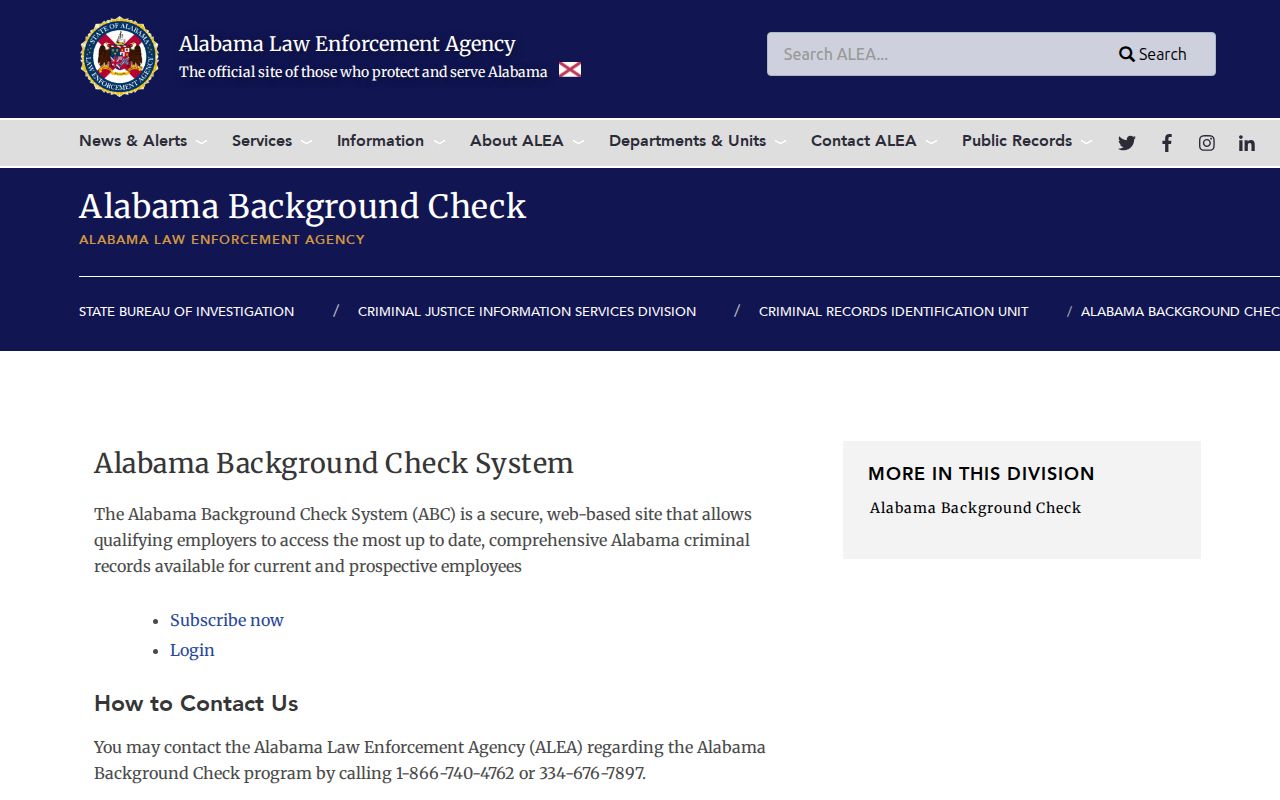
ALEA's repository record can show a submitted disposition, but it is not a copy of the DeKalb County pleadings or Case Action Summary.
Older, delayed, unautomated, or locally retained records may not appear in ALEA's file. If a disposition is wrong, first obtain official court proof, then use ALEA's challenge process with the supporting record.
DeKalb County and Federal Cases
Federal criminal cases from DeKalb County do not sit in the DeKalb County Circuit Clerk's file. DeKalb County is in the U.S. District Court for the Northern District of Alabama. The listed Anniston courthouse is at 1100 Gurnee Avenue, but its official location page warns that it has no Clerk's Office to accept filings. Federal DeKalb County docket access runs through PACER or the federal clerk, not Just One Look.
The Northern District's Anniston location page supplied the federal court image.
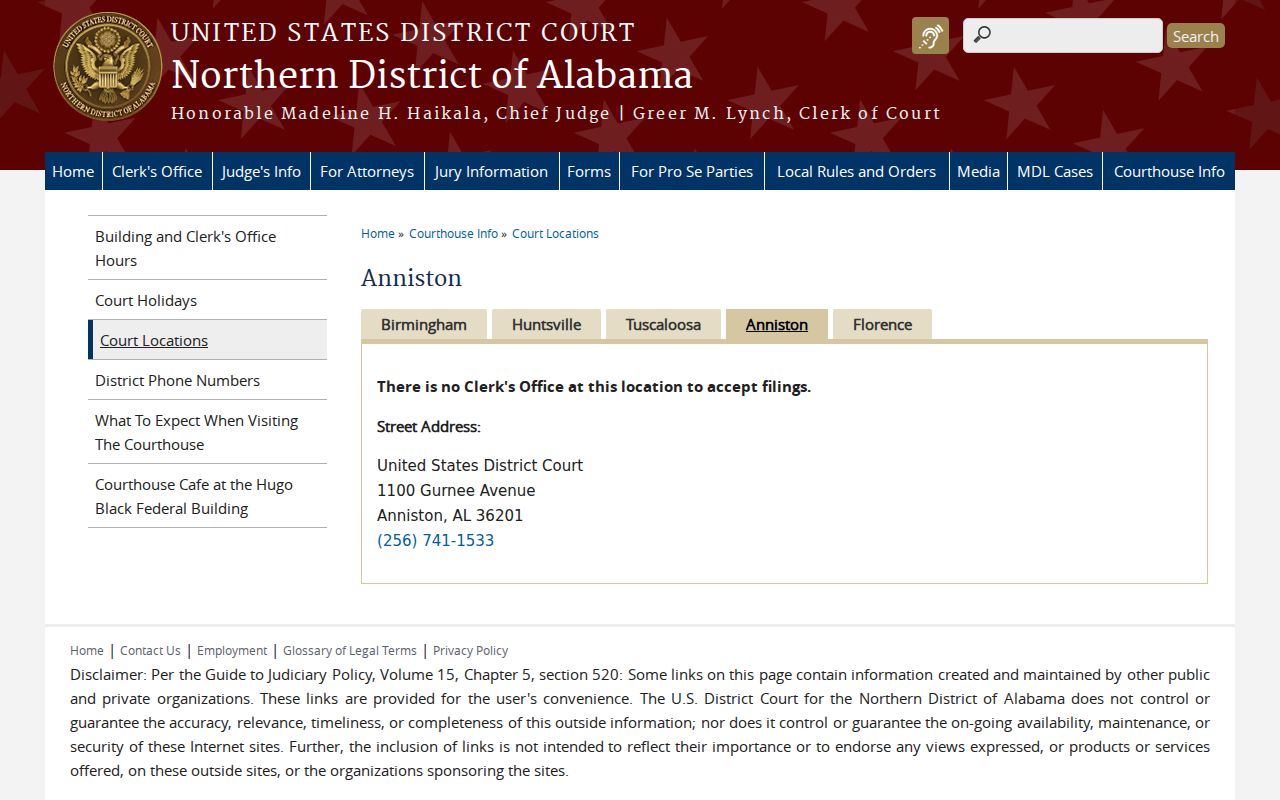
The location warning helps prevent a DeKalb County requester from sending a federal filing to a building without an intake clerk.
Access & Restrictions
Alabama court-record privacy Rule 104 generally permits inspection and copying unless a record is sealed, confidential, or restricted by statute, rule, or court order. Fees may apply. Alabama's public-writings right under Ala. Code § 36-12-40 is a baseline, not a guarantee that each criminal-history field is open.
Expunged DeKalb County records, Youthful Offender material, and court-ordered confidential records fall outside routine public access. Personal identifiers may be redacted while a nonconfidential part remains open. If a DeKalb County case does not appear online, ask the DeKalb County clerk whether it is archived, municipal, federal, too new to index, sealed, or under another spelling. Do not assume that no online match means no DeKalb County case.