
Running a Sex Offender Check in DeKalb County
Three official layers answer different parts of a DeKalb County sex offender check. The Alabama Law Enforcement Agency maintains the Alabama Sex Offender Registry and routes the public through its Community Information Center. The DeKalb County Sheriff's Office publishes a county-focused list and runs the local Sex Offender Registration Division. The U.S. Department of Justice's national search adds participating registries outside Alabama.
Start with the ALEA route when searching by name, city, ZIP code, county, or geographic area. Then compare the DeKalb County list, which offers list and slideshow views plus a direct route back to the state and national systems. Use NSOPW when the question crosses state lines. Each channel depends on data supplied through registration and agency updates, so a result should be read with its status, offense basis, and reported location rather than treated as a stand-alone safety judgment.
The Sheriff's official Sex Offender Registration Division page shows the local duties behind the county system.
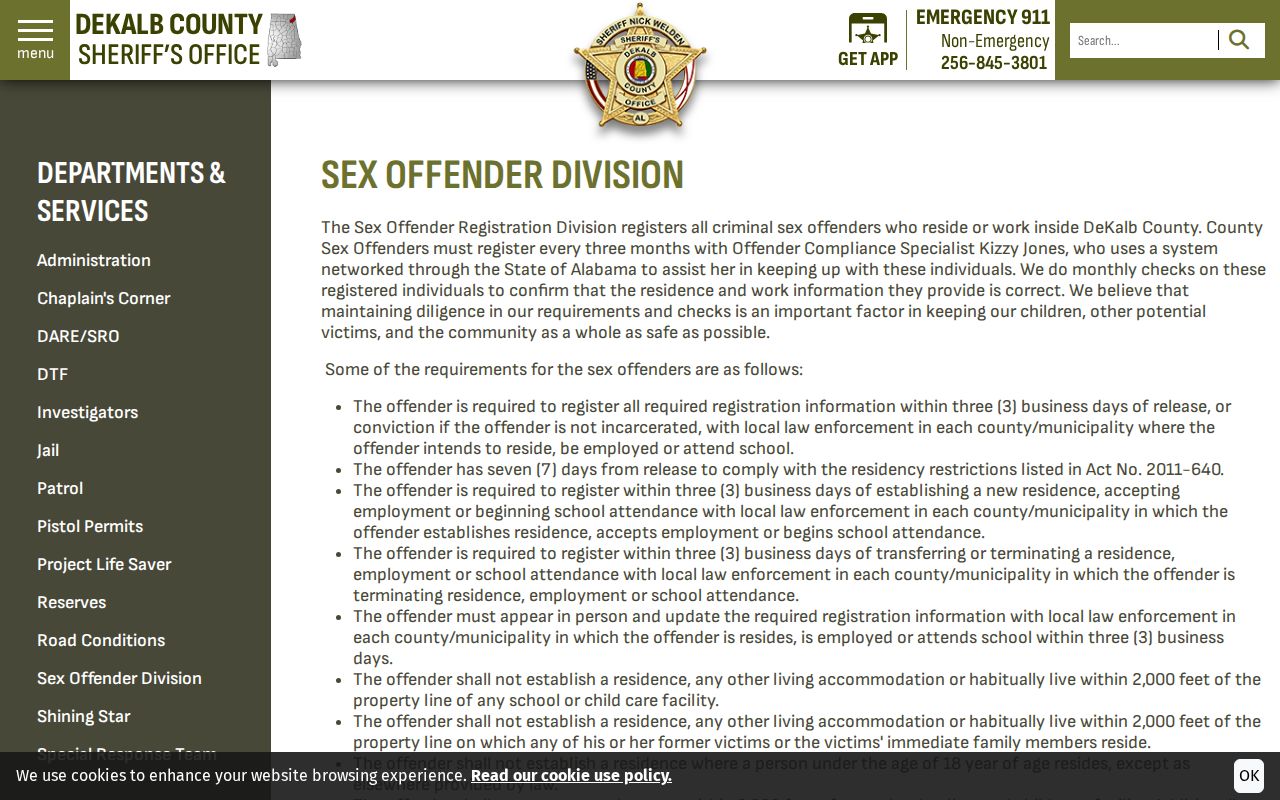
The division's registration, verification, and reporting role explains why the sheriff is the first local contact for a suspected address error.
DeKalb Registry: County, ALEA, NSOPW
The DeKalb County list is the narrowest view. It helps a reader focus on registrations tied to the county and supplies the sheriff's own warning that a listed address can be wrong because the system relies on information reported by the registrant. ALEA supplies the statewide legal and data framework. NSOPW sends one query across participating state, territorial, tribal, and District of Columbia registries, but it does not replace a close Alabama search.
| Official channel | Best use | Important limit |
|---|---|---|
| DeKalb County Sheriff's list | County-focused list or slideshow review | Reported addresses may contain errors |
| ALEA registry route | Alabama name and location search | A listing is not a current risk score |
| NSOPW | Cross-state name or location search | Location results depend on coordinates supplied by each registry |
The DeKalb County offender-list interface makes the county layer visible without republishing anyone's identity here.
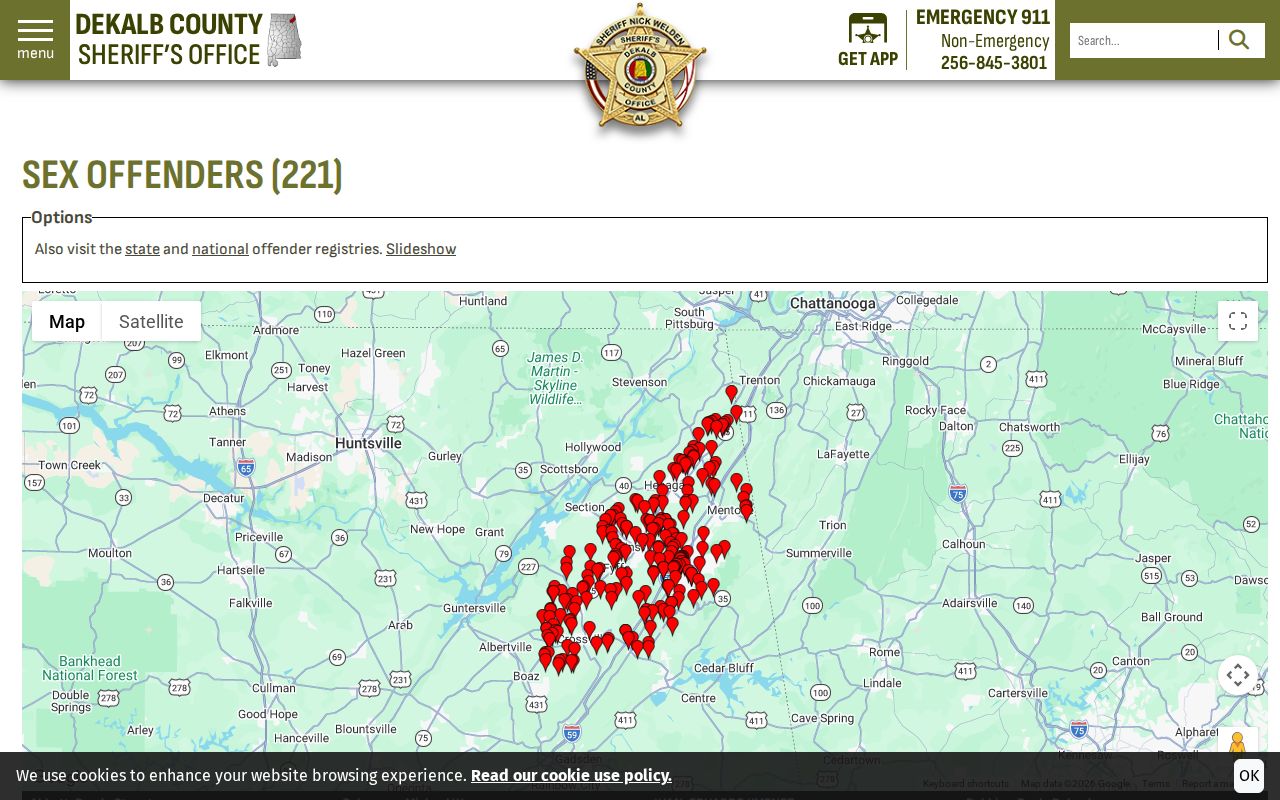
The county view is useful for local awareness, while the linked state and national channels help check beyond the county boundary.
Searching the Alabama Sex Offender Registry
ALEA's Community Information Center is the trusted starting point because it routes users to Alabama's official public registry destination. The vendor-hosted destination is still an official channel when reached from ALEA. The live vendor page was protected by a JavaScript challenge during research, so the fields below are limited to search capabilities required by Alabama law and verified through ALEA's route. No fee or account requirement is advertised.
- Open the ALEA Community Information Center and choose its Sex Offender option.
- Search by name when identity is known, or use city, county, ZIP code, or geographic radius for place-based awareness.
- Compare the results carefully and open the full profile that matches the available facts.
- Read the conviction basis, registration status, and reported location before checking the DeKalb County list for local context.
| Field or control | Type | Required | Verified notes |
|---|---|---|---|
| Name | Text search | Unspecified | Search capability required by Ala. Code § 15-20A-8(e) |
| City or town | Location search | Unspecified | May narrow an Alabama location query |
| County | Location selection | Unspecified | Select DeKalb for a county search |
| ZIP code | Location search | Unspecified | Supports ZIP-based awareness |
| Geographic radius | Radius search | Unspecified | Exact live radius choices were not recoverable |
| Search | Button | Not applicable | Runs the selected query |
The ALEA Community Information Center registry route identifies the state-approved entry point.
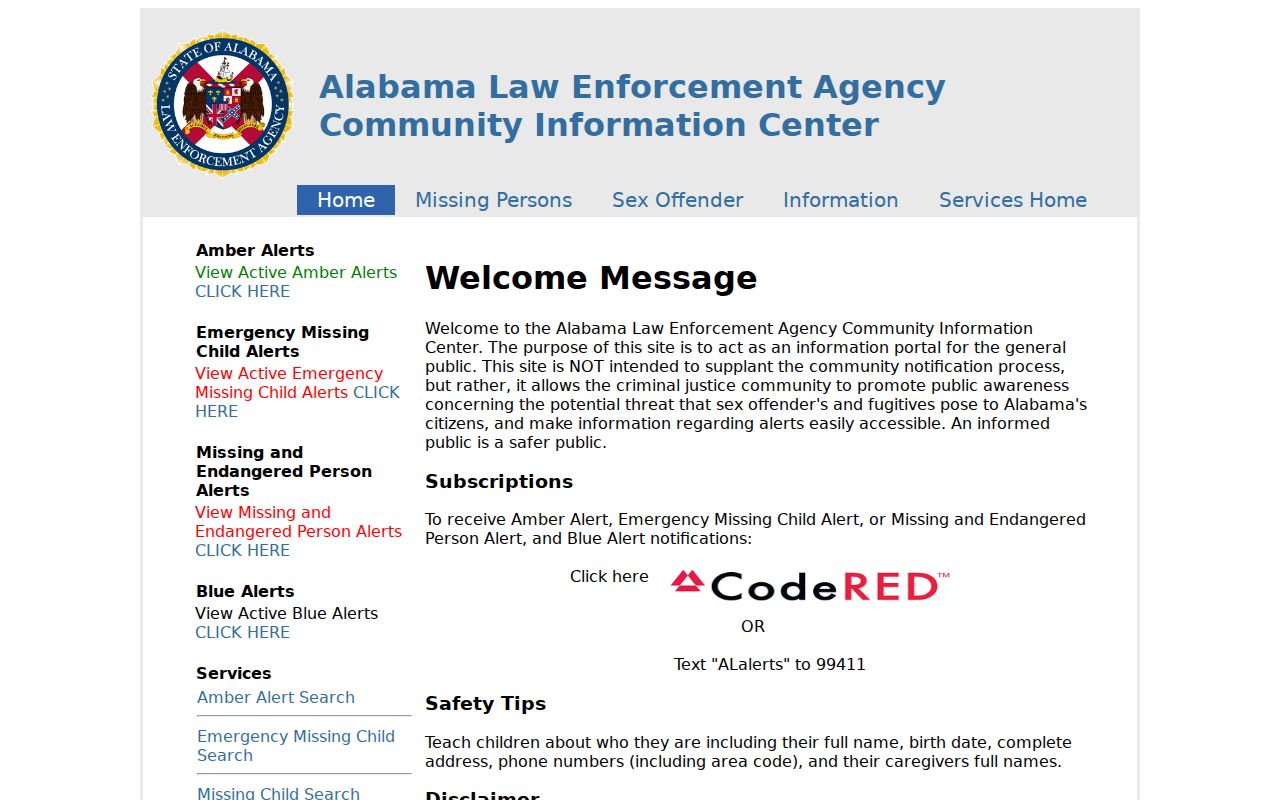
Entering through ALEA helps distinguish the official registry path from commercial sites with similar names.
Quarterly DeKalb County Registry Visits
The DeKalb County Sheriff's Sex Offender Registration Division is at 2801 Jordan Road SW, Fort Payne, AL 35968. Published lobby hours are Monday through Friday, 8:00 a.m. to 4:00 p.m., and the 24-hour non-emergency number is 256-845-3801. The division registers people who reside or work in DeKalb County through a system linked with the state.
The sheriff states that county registrants appear every three months. The office also conducts monthly checks of reported residence and work information. Those are separate acts: the scheduled in-person reporting duty does not remove the agency's local verification role. New registration is due within three business days after release or, when there was no incarceration, conviction. A person must also report a new or ended residence, job, or school attendance in person within three business days.
The sheriff also publishes the free Dekalb County Sheriff Alabama app, which advertises sex-offender access and special alerts. Official downloads are available through Apple's App Store and Google Play. The app supplements the web list and does not replace profile review or direct reporting to the registration division.
DeKalb County Sex Offender Registration Division
2801 Jordan Road SW
Fort Payne, AL 35968
256-845-3801
Monday-Friday, 8:00 a.m.-4:00 p.m.
Travel also creates a local reporting duty. Planned travel away from a residence for three or more straight days requires an in-person report within three business days before leaving the jurisdiction and a sheriff-issued travel permit.
What a Registry Profile Shows
An Alabama registry profile is conviction-based. It can identify a listed person, describe the public registration status, show reported locations, and state the qualifying offense. It should not be described as an arrest file, a new allegation, or a forecast of conduct. Some data collected on ALEA Form 47 is kept for law-enforcement registration but is not made public merely because the form contains it.
| Name and aliases | Permitted names, aliases, nicknames, and a current photograph. |
|---|---|
| Physical description | Public descriptors may include sex, race, hair, eyes, height, weight, skin tone, scars, marks, and tattoos. |
| Reported location | Residence or homelessness description, city, county, state, ZIP, and a temporary residence when applicable. |
| Work and school | Names and addresses tied to work, school, vocation, or volunteer service when public under state law. |
| Vehicles | Plate or registration information, description, and frequent or permanent location; registration data may also cover watercraft and aircraft. |
| Offense | Qualifying offense, jurisdiction, conviction or adjudication date, and public disposition information. |
| Registration status | Compliant, non-compliant, absconded, unknown, or another displayed registration status. |
| Not public by default | Social Security number, DNA sample, fingerprints, medical data, and other sensitive law-enforcement identifiers. |
A profile can support a careful identity match, but the DeKalb County warning about reported addresses still matters. Check status and source before drawing conclusions from a location alone.
Wrong DeKalb County Registry Addresses
Do not visit the address or contact the person. The county list expressly says that an address may be incorrect because it depends on registrant-supplied information. The practical correction channel is the DeKalb County Sheriff's Office, which transmits local residence and work information into the networked system and performs local checks.
Call 256-845-3801 to report suspected child contact, prohibited proximity, a displayed address that appears wrong, or possible noncompliance. Use 911 only when there is an immediate emergency. Give the agency the page or profile at issue and the reason the displayed fact appears inaccurate. Let law enforcement compare it with registration records and field verification. A resident should not infer a crime merely from a stale or disputed map point.
ALEA Administrative Rule 760-X-3-.01 requires registering agencies to send new or changed information at once in a secure electronic form. ALEA then enters that information in the state database and distributes it as the law directs. That flow is why a wrong local address goes first to the sheriff even though ALEA operates the statewide registry.
Registration Requirements and Levels in Alabama
Alabama does not present adults on its public registry through a generic federal Tier I, II, or III current-risk scale. Adult coverage follows the Alabama Sex Offender Registration and Community Notification Act and is generally lifetime. Juvenile cases use court-determined risk categories that affect who receives notice. The distinction matters because publication of an adult profile does not mean ALEA assigned a current dangerousness score.
| Alabama category | Public-notification treatment | Duration and verification |
|---|---|---|
| Adult subject to ASORCNA | Public registry and local notice under the Act; no generic public risk tier | Generally lifetime under § 15-20A-3(b); birth-month and quarterly in-person verification, with narrow relief petitions under § 15-20A-24 |
| Juvenile, low risk | Registration may apply, but broad public notice is restricted | Court-determined under §§ 15-20A-26 through 15-20A-28 |
| Juvenile, moderate risk | Notice to schools and childcare facilities within three miles, not general dissemination by other methods | Court-determined; some cases last 10 years, while lifetime orders verify quarterly |
| Juvenile, high risk | Public notified in the same manner used for an adult | Governed by juvenile provisions and the court's order |
Relief can exist in narrow circumstances, but a registry lookup cannot decide eligibility. The statute, court order, age at adjudication, offense, and other case facts control.
DeKalb County Registry Notification Zones
Two different distance rules can be confused. The DeKalb County division describes a 2,000-foot residence buffer from schools and childcare facilities and from a former victim or that person's immediate family. It also describes limits on residing with minors, subject to statutory exceptions. The county page states that a person has seven days after release to comply with residence restrictions.
Household notification uses a separate population-based rule in Ala. Code § 15-20A-21. The radius is 1,500 feet in Alabama cities with at least 5,000 residents, apart from the four large cities named in the statute. It is 2,000 feet in smaller municipalities and unincorporated places. Schools and childcare facilities within three miles receive notice. DeKalb County therefore does not have one correct household-notification radius for every address.
The address's municipality and population category determine the household radius. That is a notice rule, not a guarantee that every profile location is exact. The county correction channel remains essential when the displayed address does not match known facts.
Lawful Use and Community Notification
Registry information supports personal, family, and neighborhood awareness. It should be used to understand a public profile, plan reasonable safety steps, and alert law enforcement to a suspected error or violation. Alabama's public warning also explains that ALEA has not made an individual assessment of current dangerousness or the chance of reoffense. Inclusion follows a qualifying conviction and state law.
Misusing registry information can be a crime: Ala. Code § 15-20A-8(h) warns that using registry data to unlawfully injure, harass, or commit a crime against a listed person or anyone at a reported address can bring civil or criminal penalties. Do not confront a suspected violator; contact the DeKalb County Sheriff's Office.
Community notice also varies by location, as do the people and institutions that receive it. A registry count is not a local crime rate, and it does not show how many offenses occurred in DeKalb County. It is a changing count of public registrations connected to the county at a given time.
NSOPW for DeKalb Registry Searches
NSOPW is useful when a name or place search should extend beyond Alabama. The federal site searches participating jurisdictions and supports both name and location queries. Its location interface offers one-, two-, and three-mile choices. A location result can still be incomplete when a state has not supplied the geographic coordinates needed for mapping.
The U.S. Department of Justice NSOPW search shows the national layer available to DeKalb County residents.
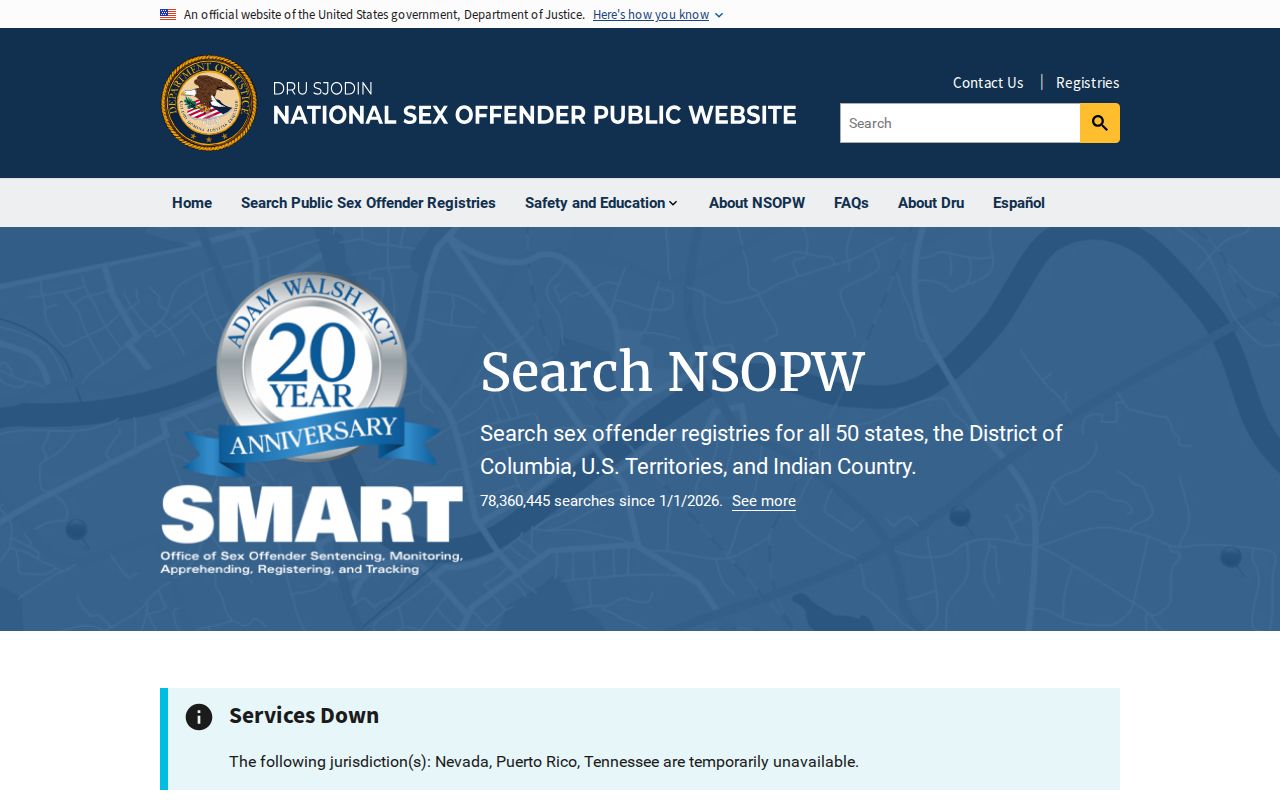
When NSOPW flags missing Alabama coordinate data, return to the ALEA route and search by name, DeKalb County, city, or ZIP code.
Read the full source profile after any national result. NSOPW is a discovery layer across registries, while ALEA and the DeKalb County Sheriff's Office remain the best channels for Alabama status, local address reporting, and corrections.