
How to Check Criminal History in DeKalb County
Start with the record's purpose, not a broad name search. Just One Look covers Alabama trial-court cases and accepts a name or case-number search. It charges $9.99, including one Case Detail, and even a no-match response is billable. The DeKalb Circuit Clerk is the next stop for certified, archived, paper, or portal-missed Circuit and District records. A recent arrest starts with the arresting agency and the county jail roster. A review of your own statewide fingerprint history goes to the Alabama Law Enforcement Agency.
Gather the full name, any alias, date of birth when the official form permits it, the likely court, and a case or booking number if known. The more exact the identifiers, the less risk of mixing two people. Keep the source and inspection date with any result because a booking allegation may later change, and a court disposition can be posted after the first arrest entry.
- Choose court, arresting agency, jail, municipal court, or ALEA based on the record needed.
- Search the official portal with a name or known case number and save the exact record identifier.
- Call the record-holding office when the portal is down, the result is unclear, or current bond data matters.
- Compare an arrest or booking entry with the filed court case and final disposition.
- Order a certified clerk record or use ALEA's fingerprint process when an official copy is required.
Why DeKalb Criminal Records Split
DeKalb County criminal history is not one file. The arresting office writes the incident or arrest report. The Detention Center creates the booking and custody entry. The Circuit Clerk creates the state-court docket, rulings, financial entries, disposition, and sentence. ALEA then maintains fingerprint-linked arrest cycles and submitted outcomes in the state repository. A municipal citation can remain with a city court, and a federal case belongs in the Northern District of Alabama.
The Sheriff's official home page is the local entry point for jail and public-safety services.

The image reinforces why sheriff records are one layer of a DeKalb County criminal history search, not a replacement for the clerk or ALEA.
| Record | Main custodian | Best use |
|---|---|---|
| Incident or arrest report | Arresting sheriff or city police agency | Event and arrest circumstances |
| Booking record | DeKalb Detention Center | Recent custody, intake charge, and bond display |
| Court case | DeKalb Circuit Clerk or municipal clerk | Filed charge, docket, result, and sentence |
| Alabama CHRI | ALEA CJIS | Your own fingerprint-associated statewide history |
Official Alabama Background Checks
ALEA does not provide an unrestricted public name-search portal. Its Alabama Background Check System is restricted to qualifying subscribers. The public route is a review of one's own Alabama Criminal History Record Information. The application requires ALEA CJIS Form 46, a qualifying photo ID, classifiable fingerprints taken by an authorized law-enforcement agency with an FBI-issued ORI, and a $25 cashier's check or money order. Each added copy is $5. ALEA says to allow at least four to five weeks after receipt.
DeKalb County residents can ask the Sheriff's booking center about civilian fingerprinting at 2801 Jordan Road SW. It is published for weekdays from 8 a.m. to 4 p.m., with no appointment, but staff handle it as booking work permits. Bring the cards and photo ID. The sheriff does not publish the fee or promise that every card and ORI will meet Form 46, so confirm both at 256-845-8565 before the visit.
The ALEA Criminal Justice Services description shows the statewide criminal-record structure.
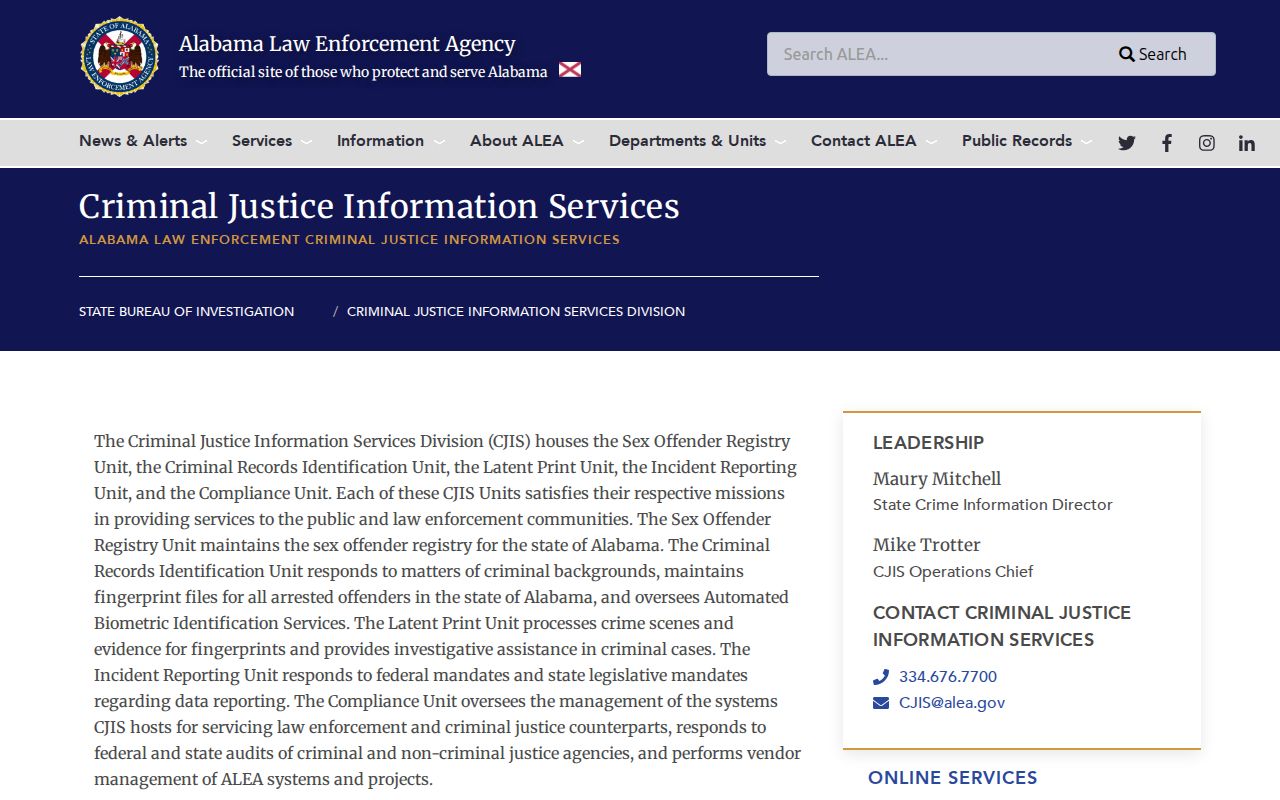
This source helps distinguish a fingerprint-linked ALEA record from the pleadings and docket in one DeKalb County case.
DeKalb Sheriff's Criminal Record Counter
The current sheriff site identifies Administration, not a separately named Records Division, as the office that manages deputy and investigator case files, enters warrants and civil process, handles extraditions, and supports registration duties. Use the published name. For a completed event, call 256-845-3801 to ask for a deputy. A person may also report at 2801 Jordan Road SW after calling ahead so an officer is available.
The routine incident-copy rule is narrow. The victim who filed a sheriff report may receive one copy at no charge with photo identification, Monday through Friday from 8 a.m. to 4 p.m., excluding state holidays. Other releasable sheriff records may require a precise request under Alabama public-record law. No dedicated request form, fee schedule, email route, or response deadline was located.
The Sheriff Administration page identifies the unit's file and warrant functions.
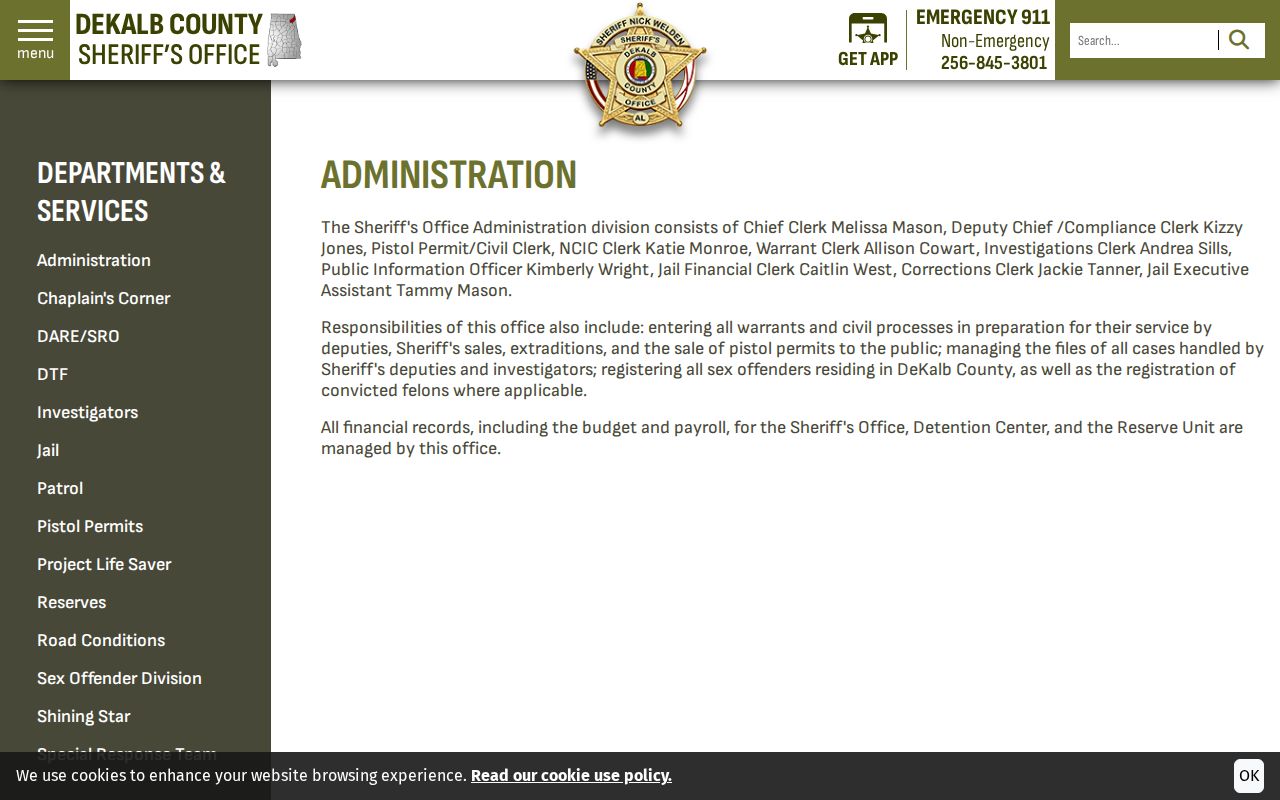
The documented unit name prevents a request from being sent to a records bureau that DeKalb County does not publish.
Sheriff Administration
2801 Jordan Road SW
Fort Payne, AL 35968
256-845-3801
Monday-Friday, 8 a.m.-4 p.m.
DeKalb Circuit Clerk
300 Grand Avenue South, Suite 200
Fort Payne, AL 35967
256-845-8525
Monday-Friday, 8 a.m.-4 p.m.
Types of Criminal Records
Each DeKalb County criminal record captures a different stage. An incident report describes the event and the agency response. A booking record documents jail intake and custody. A complaint or indictment states an accusation. The Circuit or District file tracks the court case. ALEA CHRI links reported arrest cycles and dispositions to fingerprints. A warrant comes from an issuing court, while probation, parole, prison, and registry records remain in separate systems.
- Arrest and booking records: the originating agency keeps its report, while the county jail keeps intake and custody facts.
- Criminal court files: the clerk keeps case numbers, parties, settings, rulings, costs, documents, and outcomes.
- ALEA criminal history: the state repository compiles fingerprint-associated records submitted by agencies and courts.
- Warrants: the issuing court and Sheriff's Office hold the useful status and service information.
- Supervision and registry records: ABPP, ADOC, ALEA, and the Sheriff's registry unit each keep a distinct record.
These products overlap, but none proves what every other product contains. ALEA warns that older, delayed, unautomated, missing, or locally retained matters may not appear in state CHRI.
DeKalb Jail Records Versus ADOC
The DeKalb inmate roster is the recent local-custody tool. It can be filtered for current or released records and searched by first or last name. Entries may show a booking number, age, booking date and time, arresting agency, charge text, bond, and release date. The jail warns that charges and bail can change after court appearances, so the jail line at 256-845-8565 is the source for current bail, charges, and case numbers.
ADOC Inmate Search serves a different need. It covers people currently incarcerated in Alabama state prison, has no online historical data, and excludes people sentenced as Youthful Offenders. Its AIS number search takes priority over name fields. A person absent from the county's current roster may have been released, transferred, or moved to another form of custody. The absence does not state a court outcome.
The DeKalb Patrol page supplies the county patrol and warrant-service context behind many jail records.
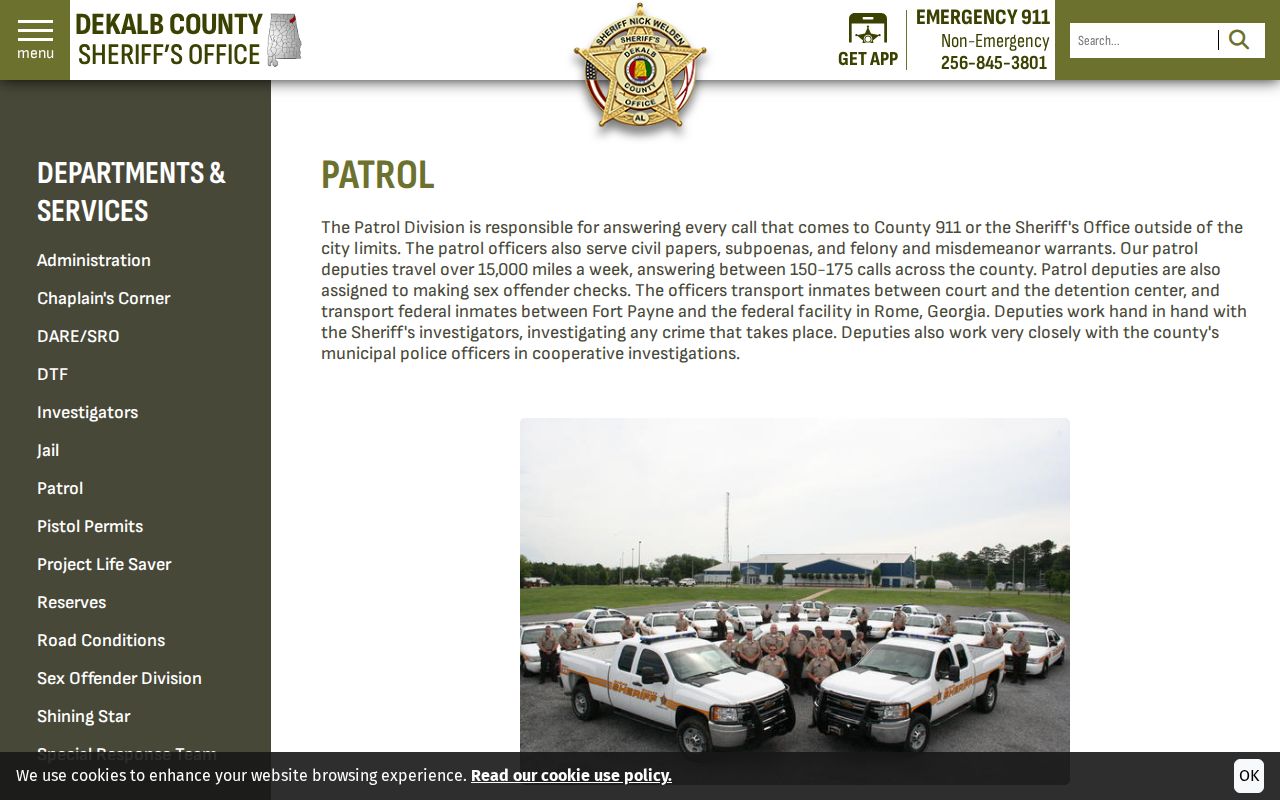
The patrol source connects the first law-enforcement record to later booking, court, and repository records without treating them as one file.
What a DeKalb County Criminal Record Shows
The fields depend on the product. A DeKalb court result can show a case number, party, status, settings, court actions, Case Action Summary, financial history, and available images. A county booking profile focuses on intake identity, agency, charge, bond, and custody. ALEA CHRI focuses on fingerprint identity, reported arrest cycles, agency and charge details, submitted outcomes, and repository identifiers. Read the label before drawing a conclusion.
| Name & identifiers | Names, aliases, demographics, and a case, booking, SID, or transaction identifier as the product permits. |
|---|---|
| Arrest / booking data | Arresting agency, booking time, intake charge, custody status, displayed bond, and release date when published. |
| Charges & filings | Booked allegations, complaints, indictments, and filed charges, which may not match one another exactly. |
| Disposition | The court outcome, such as conviction, dismissal, acquittal, or nolle prosequi. |
| Sentence | Confinement, probation, fines, restitution, and other conditions entered after conviction. |
| Custody / supervision | County jail, ADOC, probation, or parole status in the system responsible for that stage. |
DeKalb Warrants Without a Portal
The sheriff FAQ refers to a warrant database, but no working comprehensive warrant page was verified on the current site. The direct warrant line, 256-845-8560, is the strongest published lookup route. Sheriff Administration enters warrants for service, while Patrol serves felony and misdemeanor warrants. A narrow written request to Administration is the fallback for releasable information not confirmed by phone.
The Circuit Clerk holds the related county or state court file. A bench or failure-to-appear warrant may instead sit with Fort Payne, Rainsville, Henagar, or another issuing municipal court. The Most Wanted page is only a selected-publicity tool. It is not proof that no other warrant exists. Anyone resolving their own possible warrant should confirm the warrant type, issuing court, bond or payment terms, and surrender steps directly with the court and jail.
The Sheriff contact page also warns that its web form is not monitored around the clock.
This makes the phone and issuing-court fallbacks vital when an online warrant tool cannot answer the question.
Public Access Laws
The Alabama Open Records Law begins with a right to inspect and copy public writings, but it does not make every criminal-history field public. Court Rule 104 likewise allows inspection of a state court record unless a statute, rule, court order, or confidential status restricts it. Agencies can redact protected portions while releasing the rest where practicable. Pending investigations, Youthful Offender files, sealed material, and sensitive identifiers need special care.
Key laws and rules:
Ala. Code § 36-12-40 sets the public-writings inspection and copy baseline.
Ala. Code § 41-9-601 penalizes false-pretense or unauthorized criminal-history access and disclosure.
Court-Record Privacy Rule 104 permits access unless law, rule, order, sealing, or confidentiality limits it.
Ala. Code § 15-27-1 supplies eligible nonfelony and limited conviction expungement routes.
Ask for a defined record, date range, agency, and case or report number when possible. A clear request helps the custodian locate releasable material without guessing at the subject or scope.
DeKalb Criminal Record Terms
Court and jail words can look alike while marking very different steps. A booked charge is the intake allegation. An indictment is a grand jury's formal accusation. A disposition is the result entered by the court. Reading those fields in order helps prevent an arrest entry from being mistaken for the final DeKalb County criminal history.
- Arraignment
- The hearing where the charge is formally presented and a plea is taken.
- Case Action Summary
- The ordered docket of filings, settings, events, rulings, and the result.
- Nolle prosequi
- The prosecutor's formal choice not to continue a charge; it is not the same as an acquittal.
- Capias
- Court process directing custody, often tied to a failure to appear or an unsatisfied order.
- Disposition
- The outcome of a charge, including conviction, dismissal, acquittal, or nolle prosequi.
Sealed, Expunged & Restricted
Alabama expungement can remove eligible material from general public dissemination, but it does not destroy every trace for every lawful purpose. Current forms preserve limited criminal-justice, prosecutor, regulatory, protective, and related civil access. Youthful Offender material is confidential, and ADOC excludes Youthful Offender sentences from its public locator. Courts can also seal or restrict records by law or order.
A DeKalb filing uses the criminal division of Circuit Court when the original charge was filed in the county. The process starts with certified ALEA CHRI, then a certified arrest record or certified disposition and Case Action Summary. Current CR-65 identifies the charge and grounds, arresting and booking agencies, prior applications, and proof that required terms were met. The administrative filing fee is $500, with a current hardship-waiver route. Separate arrests generally require separate fees unless waived.
Note: Expungement changes public access, but it does not by itself restore firearm rights or erase every authorized agency copy.
Correcting DeKalb Criminal History
A wrong disposition on ALEA CHRI should first be supported with the official court record. ALEA's challenge asks for the CHRI copy, the arrest charge or outcome in dispute, why it is wrong, what is believed to be correct, and records from the originating agency or court. The Appendix A challenge is due within one year of ALEA's response. No fixed completion period is promised because ALEA verifies the facts with those offices.
A missing state entry does not prove that the event never happened. ALEA explains that some older charges were not submitted, some records are not automated, and some may still be held locally. Compare the Circuit Clerk's file, the arresting or jail record, and the state CHRI before deciding which source needs correction.
The Fort Payne probation and parole field office page shows one more local record channel.
That office handles state supervision routing, but its privileged files are not a public walk-in criminal-history product.
Criminal Records by City in DeKalb County
Fort Payne, Rainsville, and Henagar police departments create their own incident and arrest reports, while their municipal courts keep city citations, ordinance cases, and qualifying misdemeanors. If a city arrest leads to county custody, the DeKalb jail creates a separate booking entry. State trial cases move to the Circuit Clerk and Just One Look. Start with the agency that wrote the record, then follow the case or custody path.
The Rainsville heritage page provides the city's official local context.
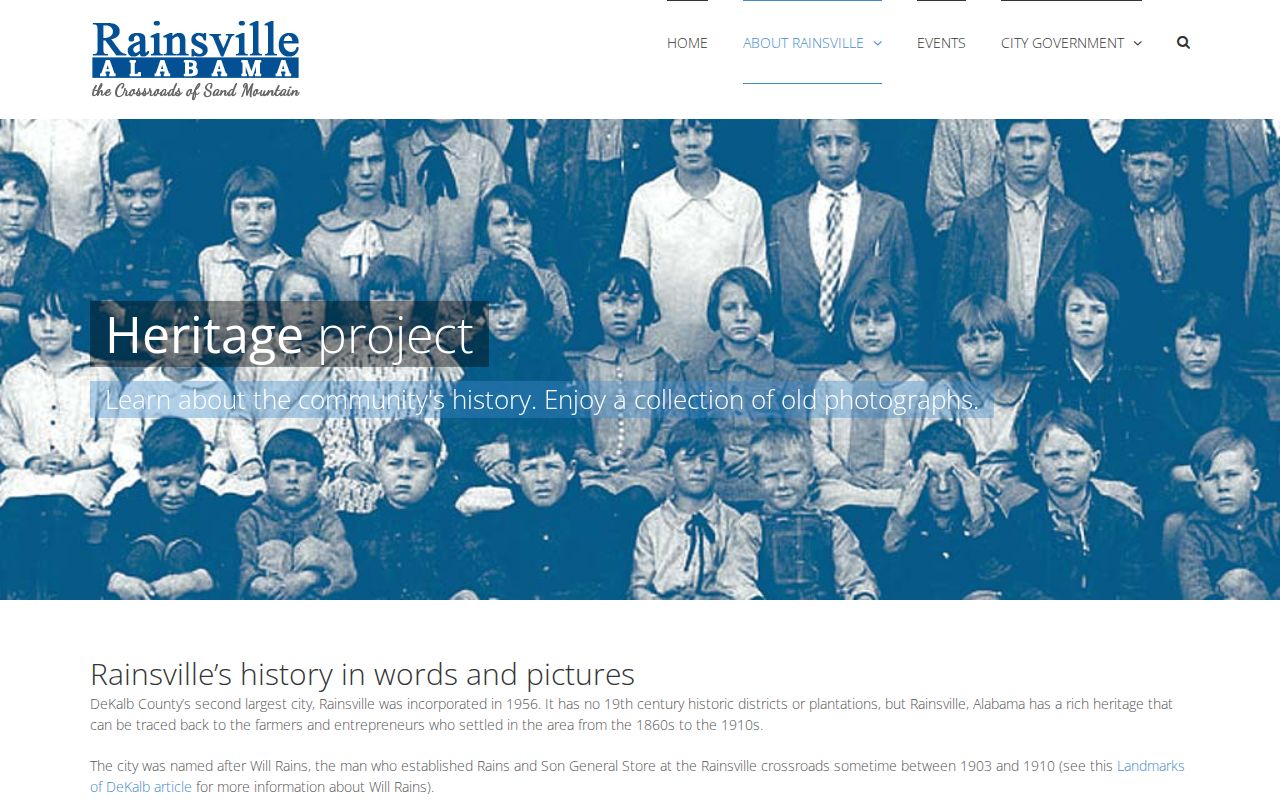
Rainsville's separate civic history mirrors its separate police and municipal-court record channels.
The official Henagar municipal citation search shows the city's public lookup controls.
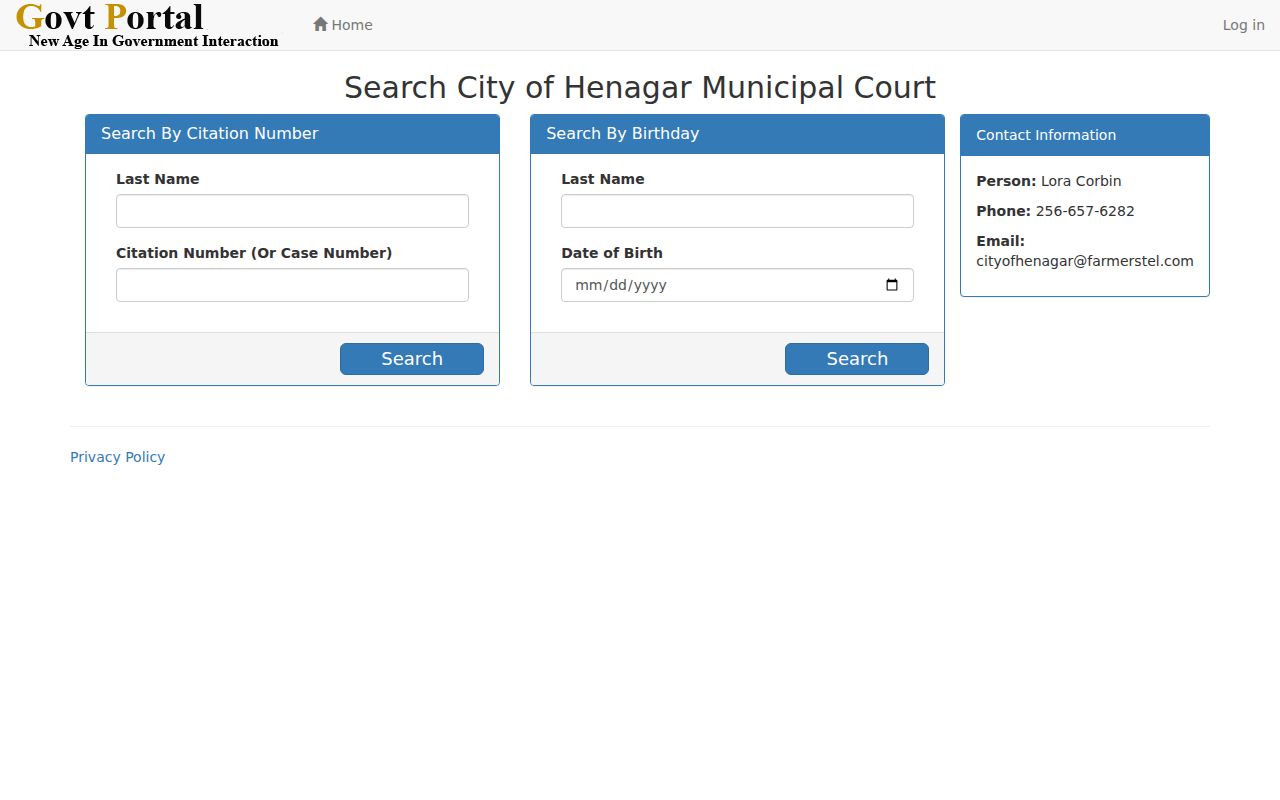
The portal searches Henagar municipal matters, not county bookings or ALEA criminal history.
Fort Payne Criminal History
15,017 residents in the 2024 estimate. Police, City Hall, and Municipal Court use separate downtown contacts.
Rainsville Criminal History
5,931 residents in the 2024 estimate. A public citation portal supports two search modes.
Henagar Criminal History
2,501 residents in the 2024 estimate. Court, police, and city-record routes remain distinct.
DeKalb Criminal Records by the Numbers
The Sheriff's 2024 operational report shows the scale of local record creation. Deputies logged 7,963 calls, made 2,989 incident or offense reports, attempted 424 warrants, and listed 4,427 arrests from warrant and warrantless work. Those are agency activity measures, not convictions or an FBI crime total. The report also lists 489 sex-offender verifications, showing how registry work creates its own record stream.
The county stretches across 777.08 land square miles, while court, sheriff, and many state-supervision contacts center on Fort Payne. Online, telephone, and mail fallbacks matter for residents across Sand Mountain, Lookout Mountain, and rural communities. The official city history also explains why Fort Payne became the county seat and records hub.
The Fort Payne history page traces that county-seat role and civic growth.

The historic center holds city and county offices, yet the record custodian still depends on whether police, jail, court, or ALEA created the file.